May
08

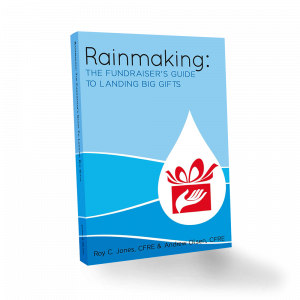
Rainmaking: The Fundraiser’s Guide to Landing Big Gifts

Two years ago my good friend Roy C. Jones and I had the bright idea to write a book designed to help fundraisers build better donor relationships and raise more money. It’s been a long road. We’ve learned a lot in the process, and had the opportunity to talk with dozens of great leaders in philanthropic communities across the U.S.

We’re excited to announce the launch today of Rainmaking: The Fundraiser’s Guide to Landing Big Gifts, available now on Amazon.

This book is packed with tips, tricks and resources you can use to more effectively engage middle and major donors, build trust-based relationships and raise a lot more money. We hope you’ll grab a copy. But more importantly, we hope you’ll read it and use what we’ve shared to raise even more money for your cause!

Rainmaking: The Fundraiser's Guide to Landing Big Gifts

Apr
07

Women Give 2012 Study

Boomer Woman

I ran across this Women Give 2012 (slightly dated) study comparing giving behaviors of women and men thanks to Gail Perry this evening.

The study compared only single adult households (excluded married households) in order to better understand gender-based giving differences.

Key findings…

1. Boomer and older women are more likely to give to charity than their male counterparts when other factors affecting giving are taken into consideration.

2. This trend is even more pronounced in households at the top 25% of income levels.

3. Senior women (age 50+) control $19 trillion and nearly 3/4 of the nation’s financial wealth.

4. According to Indiana University’s Center on Philanthropy, households headed by single females are both more likely to give and likely to give more $ than households headed by single males, regardless of age group.

5. Female Boomer and older single-headed households are nearly twice as likely to give 3% or more of their permanent income to charity than their male counterparts.

6. Female Boomer and older single-headed households in the top 25% of income brackets more than twice as likely to give 3% or more of their permanent income to charity than their male counterparts.

7. Baby Boomer & older women give 89% more $ to charity than comparable male counterparts.

8. Baby Boomer & older women in the top 25% of income brackets give 156% more $ to charity than comparable male counterparts.

All of these findings reinforce the need among nonprofits to have specific engagement and cultivation strategies for their female donors and other women throughout their communities.

Questions nonprofits should ask themselves based on this information:

1. Do we have appropriate female representation (by age, community stature and philanthropic capacity) on our board and corporate leadership team?

2. Do we know what motivates female donors and are we being intentional about integrating those items into our cultivation strategies (including who the right person is to cultivate the donor)?

3. Are our stewardship efforts aligned to be meaningful to key female donor groups?

4. Are we aggressively courting important female leaders and influencers in the community for strategic volunteer and philanthropic engagement opportunities?

5. Is the content in our planned gift marketing program designed to speak to a female audience?

6. Are we asking our high capacity female donors for the appropriate gift amounts compared to their male counterparts of similar capacity?


Image courtesy of [image creator name] / FreeDigitalPhotos.net

Mar
09

Check out my guest posts at Christian Leadership Alliance

Christian Leadership Alliance I’m honored to have a few recent posts featured on Christian Leadership Alliance’s new blog. Go visit the CLA blog and check out my guest posts on Fundraising: Instinct vs. Insight and 13 Ways to Engage Major Donors.

Jan
21

The fundraiser’s spring cleaning checklist

It’s that time of year again. Time to clean out your development operation, reorganize and re-prioritize your efforts and rid your organization of the fundraising clutter that keeps you from maximizing your success.

Use this fundraiser’s spring cleaning checklist to help get your house in order and get you focused on the most important tasks for your organization:

Build your development plan (if you haven’t already). Establish goals, budgets, strategies and tactics for your success.

Map out an integrated communication plan. Instead of planning month-to-month, take a few days early in the year and map out your communications and fundraising efforts for the entire year. This will give you vision to opportunities for integration and allow you to plug holes you didn’t realize existed.

Review your prospect list. If there are prospects you haven’t been able to engage over the last year, move them to the bottom of your list. They are a low priority. Focus on those who are most engaged and who have the greatest capacity. Don’t waste your time on people who aren’t interested in talking with you.

Update your major donor cultivation plans. You’re coming out of the busiest fundraising season of the year. Chances are you worked so long and hard over the last few months that you may not have taken the time to fully update major donor records in your database. Do that now, and incorporate what you learned over the holidays to make necessary changes to your ongoing major donor cultivation plans.

Invest in Search Engine Marketing and online display advertising. If you aren’t already running SEM and online display, now’s the time to start. Done right, many nonprofits can achieve a 1:1 ROI or better on combined SEM/display campaigns while also acquiring new, high value online donors.

Re-evaluate your special event efforts. If your events aren’t producing the results you expect, stop doing them. Ineffective events waste more time, money and goodwill than you might expect. Redeploy your resources where you’ll have better ROI.

Refresh your thank you receipt copy. If you’re like a lot of nonprofits, you probably use a static thank you letter for most, if not all of your donor gifts. It’s quick and easy for you. But your donors are bored with it, and by sending the same thank you letter copy every time, you’re showing donors you don’t care about them and their needs – just their money.

Get out there and ask!

Older posts «